If you run out of prescription medication while traveling internationally, you may be able to buy or replace it abroad — but the rules vary significantly by country, medication, and pharmacy system.
The safest strategy is still to travel with enough medication for your entire trip, plus extra for delays. The U.S. State Department specifically recommends carrying sufficient medication, keeping it in original packaging, and bringing copies of your prescriptions.
But if you lose medication, extend your trip unexpectedly, or need an emergency refill, here is what U.S. travelers should know.
Can a U.S. prescription be filled in another country?
Sometimes, but do not assume a U.S. prescription will be accepted directly by a foreign pharmacy.
Prescription rules are determined locally. A medication that requires a prescription in the U.S. may be sold differently abroad, while another medication may require an evaluation and prescription from a locally licensed doctor.
The FDA advises travelers not to assume that a drug approved in one country is approved or legally available in another.
If you need a replacement, a practical route is often:
local doctor or clinic → local prescription → reputable licensed pharmacy
The U.S. embassy or consulate for your destination can also provide information about local doctors and hospitals.
Bring the generic name, not just the brand name
Brand names often differ between countries.
Before traveling, keep a record of:
- medication brand name
- generic/active ingredient name
- strength
- dosage form
- dosing schedule
- prescribing doctor's information
The CDC recommends carrying copies of written prescriptions that include the generic names of your medications.
For example, knowing only a U.S. brand name may make it harder for an overseas doctor or pharmacist to identify an equivalent product.
Be especially careful with GLP-1s, insulin and biologics
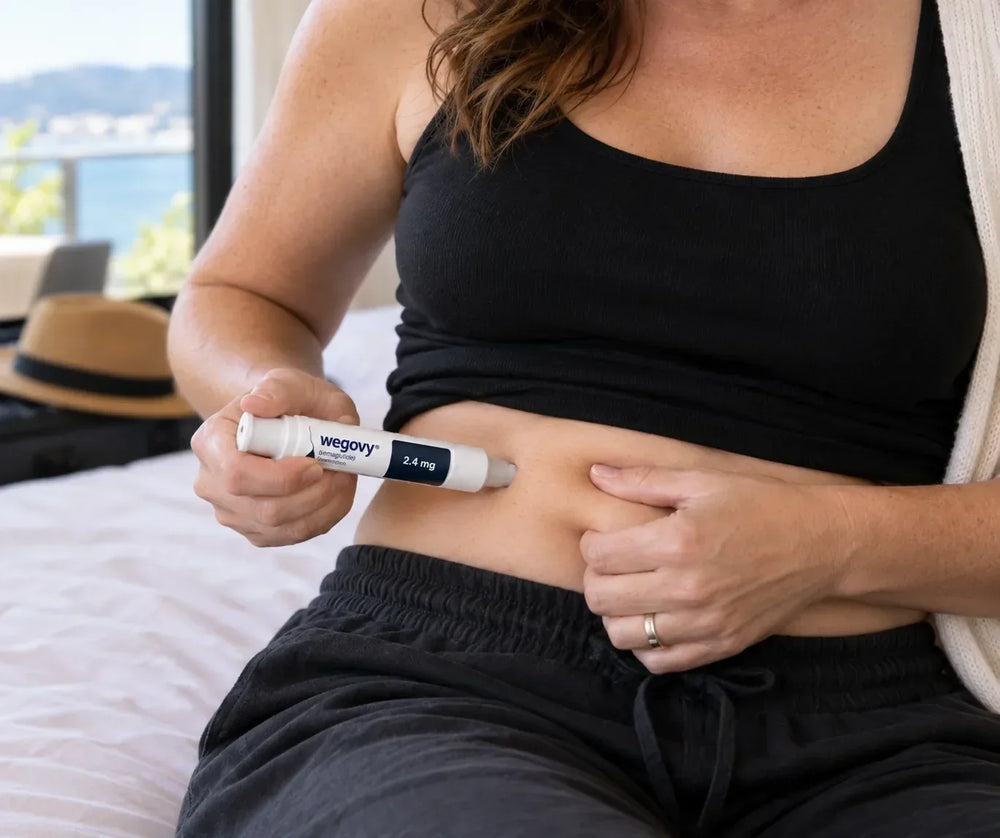
Travelers using injectable medications such as Ozempic, Mounjaro, Wegovy, Zepbound, insulin, or biologics face an additional issue: finding the medication is only half the problem.
You also need to confirm:
- the exact formulation and strength
- whether the device or presentation differs from the U.S. version
- storage requirements
- refrigeration history
- whether the product came through a legitimate pharmaceutical supply chain
A medication that looks similar may not necessarily be the same presentation you use at home.
For temperature-sensitive injectables, ask the pharmacist how the product was stored before purchase and follow the manufacturer's instructions for transportation after purchase.
Counterfeit medications are a real concern
The CDC specifically warns that counterfeit drugs are common in some countries and recommends bringing your own medication whenever possible. If you must purchase medicine during an emergency, use a legitimate source.
The State Department likewise warns travelers in multiple country advisories that counterfeit medicines may contain the wrong strength, ineffective ingredients, or potentially dangerous substances, and recommends buying through reputable pharmacies with help from a medical professional.
Avoid purchasing prescription drugs from:
- street vendors
- informal markets
- unknown websites
- social-media sellers
- shops with unclear pharmacy credentials
When possible, use a licensed pharmacy recommended by a local physician, hospital, insurer, hotel medical service, or U.S. embassy resource.
Some medications may be restricted or illegal abroad
A prescription that is completely legal in the U.S. may be controlled or prohibited in another country.
This is particularly important for certain:
- ADHD medications
- narcotic pain medicines
- sleeping medications
- anxiety medications
- controlled substances
The State Department recommends checking with the embassy of every country you visit or transit through because some destinations require permits or impose specific limits.
The CDC notes that violating local medication laws can result in confiscation, fines, or even detention.
Can you bring medication purchased abroad back to the U.S.?
This is where travelers need to be especially careful.
The FDA states that, in most circumstances, it is illegal for individuals to import foreign drugs into the United States for personal use when those products are not FDA-approved for U.S. use.
There is a limited FDA personal importation policy under which officials may exercise discretion in certain circumstances, generally involving serious conditions, products not commercially available in the U.S., no unreasonable risk, personal use, and typically no more than a three-month supply. But this is not a blanket right to bring foreign prescription drugs home.
So buying medication abroad for use during your trip and bringing leftover foreign medication back into the U.S. can involve very different legal questions.
What to do if you lose your medication overseas
A simple emergency plan is:
- Contact your U.S. prescriber or pharmacist. Ask for your prescription details, generic drug name and dosing information.
- Check local rules. Find out whether the medication is available and whether a local prescription is required.
- Use a reputable local doctor or clinic if necessary.
- Fill the prescription at a licensed pharmacy.
- For temperature-sensitive medication, confirm storage requirements immediately and arrange appropriate transportation and refrigeration.
- Before bringing any foreign-purchased medication back to the U.S., check current FDA and CBP rules.
The U.S. State Department can also help travelers locate medical services abroad, although you remain responsible for medical and pharmacy costs.
The best strategy: bring more than you expect to need
The easiest way to avoid an overseas prescription problem is to prepare before departure.
The State Department and CDC recommend bringing enough medication for your trip, with extra for unexpected delays, along with prescription documentation.
For travelers carrying temperature-sensitive medications, like GLP-1 medications, carrying a travel cooler case like Eurolabx is a good choice as it accommodates up to 4 pens of all types. Using a cooler case gives you a peace of mind during travel because obtaining a replacement injectable medication overseas can be considerably more complicated than replacing a common tablet.
Bottom line
Yes, you may be able to buy prescription medication outside the U.S., but availability, prescription requirements, brand names and laws vary by country.
If an emergency refill becomes necessary:
use a legitimate medical professional + licensed pharmacy + your medication’s generic name and prescription information.
And do not assume that medication purchased abroad can automatically be brought back into the United States. FDA import rules apply separately.
________________________________________________________
References:
U.S. State Department — Medicine and Health Abroad
CDC — Traveling Abroad With Medicine