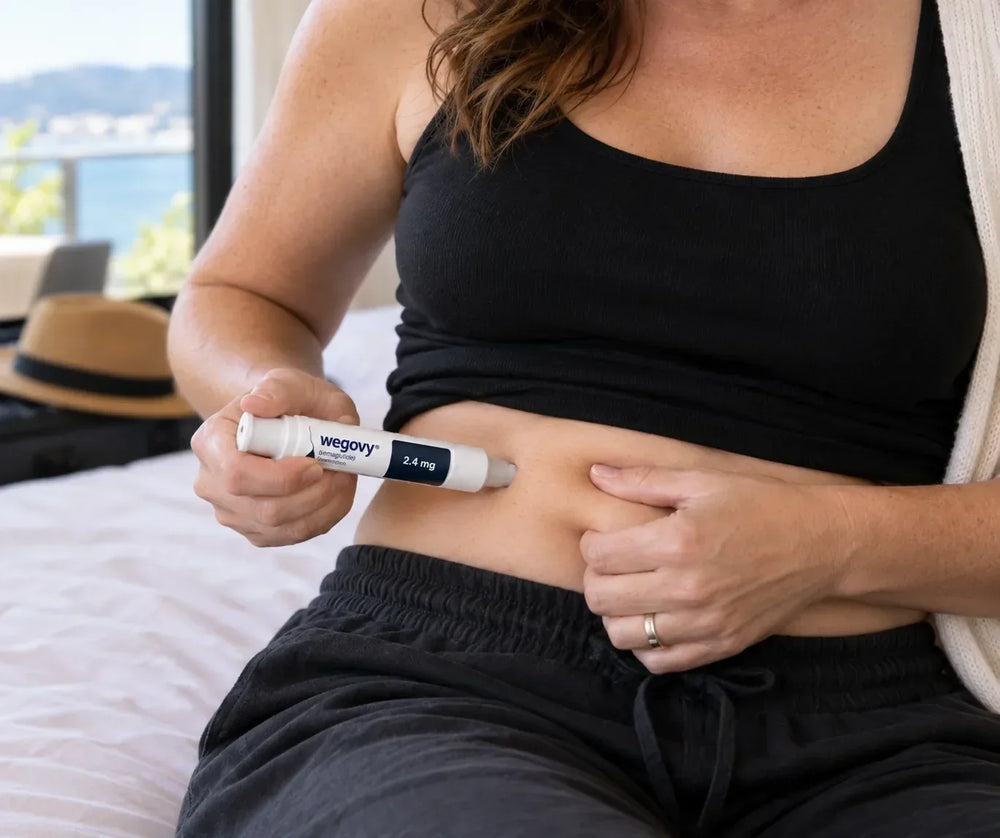
Heatwaves are becoming increasingly common around the globe and can affect more than travel plans. They can increase the risk of dehydration, heat exhaustion and heat stroke, and can worsen chronic conditions such as diabetes, cardiovascular disease and kidney disease. Older adults and people with chronic illnesses are among those at greater risk.
For travelers using Ozempic, Mounjaro, Wegovy, Zepbound or another temperature-sensitive injectable, extreme heat creates another problem:
A medication that is normally allowed to stay at room temperature may still become too warm during a heatwave.
That distinction is important.
“Room temperature” still has an upper limit
Several popular GLP-1 medications can be stored outside the refrigerator for a defined period, but only within specific temperature limits.
For example:
- Ozempic: an in-use pen can be stored for 56 days at 59°F to 86°F (15°C to 30°C) or refrigerated. Novo Nordisk also says to keep it away from heat and not to freeze it.
- Mounjaro: U.S. single-dose pens and vials may be stored unrefrigerated at temperatures up to 86°F (30°C) for up to 21 days.
- Wegovy injection: before cap removal, the pen may be kept at 46°F to 86°F (8°C to 30°C) for up to 28 days. It should be discarded if exposed above 86°F.
- Zepbound: U.S. single-dose pens and vials may be stored unrefrigerated at temperatures up to 86°F (30°C) for up to 21 days.
So when a manufacturer says a medication can be stored at “room temperature,” it does not mean that it can safely remain in any warm environment.
Why heatwaves change the equation
During a mild day, a hotel room, carry-on bag or air-conditioned car may remain comfortably below 86°F.
During a heatwave, that is less certain.
WHO notes that reported temperatures are measured in the shade and that temperatures in direct sun can be 10–15°C hotter.
That means a 95°F day may create much hotter conditions in:
- direct sunlight
- a parked car
- a beach or sightseeing bag
- an outdoor café
- an uncooled hotel room
- airport pickup areas
- buses or taxis with weak air conditioning
A pen that does not normally require refrigeration for your trip can therefore still exceed its approved temperature limit.
Example: room-temperature storage versus a heatwave
Imagine you are traveling with a GLP-1 medication that may be stored up to 86°F.
Your destination is experiencing a heatwave with daytime temperatures around 98°F.
In an air-conditioned hotel room at 72°F, your medication may remain comfortably within its allowed range.
But if you put the same pen in a handbag for your cab ride from airport to the hotel, or for a four-hour walking tour, or leave it beside a sunny window, or take it on a hot bus excursion, the environment around the medication may rise above 86°F.
That is where temperature protection becomes useful.
When a medication cooler can make sense
During a heatwave, a travel cooler does not always need to keep a GLP-1 pen at refrigerator temperature.
Its job may simply be to prevent excessive heat exposure.
That can be useful when:
- outdoor temperatures exceed the medication’s maximum storage temperature
- you need to ride from airport to your hotel or vice versa
- you will be sightseeing for several hours
- you are taking a road trip
- you are going on a cruise excursion
- you expect long waits outdoors
- reliable air conditioning is uncertain
The objective is not:
make the medication as cold as possible
but:
keep it within an appropriate temperature range.
Don’t solve a heat problem by creating a freezing problem
Most commonly used injectable GLP-1 medications also carry warnings against freezing. So placing a pen directly against a deeply frozen ice pack can create the opposite temperature risk.
If cooling is needed, look for a travel cooler case like Eurolabx that creates some separation between the medication and frozen component through an insulating sleeve, thermal barrier or dedicated compartment.
That helps provide protection from both sides:
excessive heat ← controlled protection → excessive cold
Heatwaves affect you too
Medication protection is only one part of heatwave travel.
CDC recommends that travelers in hot climates:
- drink plenty of non-alcoholic fluids
- wear loose, lightweight clothing
- use sunscreen
- wear a hat and sunglasses
- plan outdoor activities during cooler parts of the day
- rest frequently in shade or air conditioning
Older adults and people with chronic medical conditions are more likely to develop heat-related illness.
WHO similarly recommends avoiding strenuous activity during the hottest part of the day and spending time in cool spaces when possible.
Bottom line
A GLP-1 medication that can normally be stored at room temperature may still need temperature protection during a heatwave.
The important question is not simply:
“Does my medication require refrigeration?”
It is:
“Could the environment I’m traveling through exceed my medication’s maximum approved temperature?”
If the answer is yes, a medication travel cooler can help buffer the pen from extreme heat—even when continuous refrigeration is not otherwise required.
Always check the current manufacturer instructions for your exact medication and presentation before travel.
_____________________________________________________________________
References:
Novo Nordisk — Ozempic Prescribing Information
Eli Lilly — Mounjaro Prescribing Information
Novo Nordisk — Wegovy Prescribing Information
Eli Lilly — Zepbound Prescribing Information