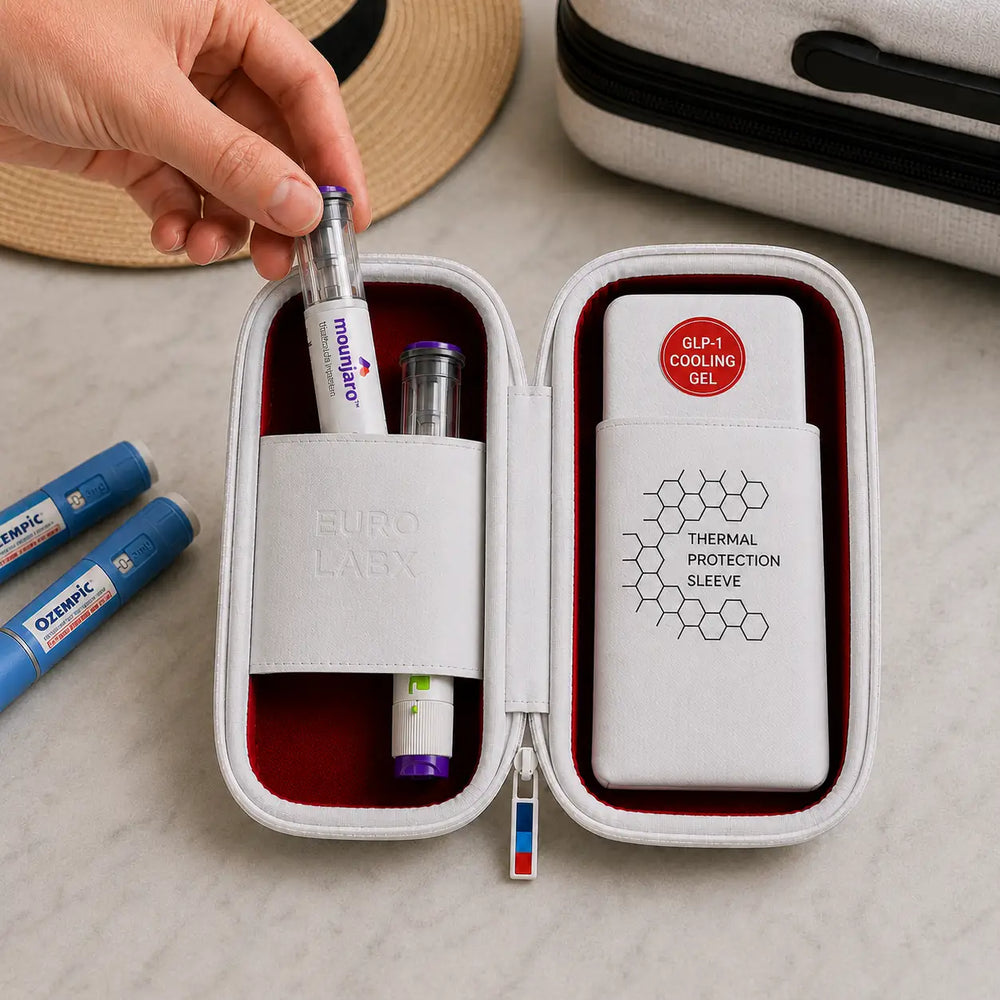
A two- or three-week international trip can put a weekly GLP-1 injection right in the middle of your itinerary. That leads to the same practical questions repeatedly: Should I skip the dose? Should I move my shot day before a long flight? How many pens do I pack? And what happens when I cross time zones or travel somewhere very hot or very cold?
For most established users, international travel by itself is not a reason to routinely stop a weekly GLP-1. The better approach is to understand the dosing flexibility for your specific medication and build a storage plan around the trip.
This article covers injectable Wegovy, Mounjaro, Zepbound and Ozempic. Always follow the instructions for the exact product and presentation you were prescribed.
1. I'm traveling for more than two weeks. Should I skip my GLP-1 shots?
Usually, don't assume that you need to.
This is a real concern among travelers. An anxious user, who recently started his shots, preparing for a trip lasting just over two weeks may consider skipping the medication entirely because he would be moving around frequently and may not want the storage hassle.
But skipping multiple doses can create a second problem: how and when to restart treatment?
The current Wegovy prescribing information is particularly clear. If two or more consecutive injections are missed, the dosage may need to be re-escalated from a lower dose to reduce gastrointestinal side effects.
For Mounjaro and Zepbound, a single missed dose can be taken within four days (96 hours). After that, the missed dose should be skipped and the regular weekly schedule resumed.
Ozempic allows a missed dose to be taken within five days.
So for a two-, three- or four-week trip, the better first question is generally:
“Can I safely bring my scheduled doses?”
rather than:
“Can I stop treatment until I get home?”
If you are considering missing more than one dose, discuss the plan with your prescriber before departure.
2. How many GLP-1 doses should you pack?
Count scheduled injection days, not simply the number of weeks you are traveling.
For example, a 16-day trip might involve two scheduled injections—or three, depending on where your regular shot day falls relative to departure and return.
The CDC recommends bringing enough medication for the entire trip plus some extra for unexpected delays, where destination rules allow it. It also recommends keeping prescription medicines in their original labeled containers and carrying copies of prescriptions.
For injectable medication, a good international packing setup is:
- Medication in your carry-on, not checked baggage.
- Original pharmacy packaging/carton, particularly for border entry.
- Prescription or medication list showing both brand and generic name.
- Doctor's letter explaining that you use a prescribed injectable medication, especially when carrying needles.
- Enough doses for the trip plus a reasonable delay buffer, subject to destination import limits.
- Appropriate temperature protection based on the medication's actual storage requirements.
The CDC specifically recommends keeping medications in carry-on baggage because checked luggage can be lost or delayed and advises travelers using injectable medications to consider carrying a healthcare-provider letter.
For flights departing the U.S., TSA allows injectable medications and unused syringes accompanying them. Medically necessary cooling accessories such as ice or frozen gel packs are also permitted, although additional screening may apply.
3. Does a 12- or 15-hour flight mean you should move your shot two days earlier?
Not automatically.
A long flight does not itself change how a weekly GLP-1 works.
The CDC's international medication guidance makes an important point for time-zone travel: medication timing should generally be considered according to time since the previous dose rather than simply the destination's local clock.
And these weekly injections already have some manufacturer-defined timing flexibility.
| Medication | Can the weekly injection day be changed? |
|---|---|
| Wegovy injection | Yes, provided the previous dose was at least 2 days earlier |
| Ozempic | Yes, provided more than 48 hours separate the doses |
| Mounjaro | Yes, provided doses remain at least 72 hours apart |
| Zepbound | Yes, provided doses remain at least 72 hours apart |
These intervals come directly from the current U.S. prescribing information.
So if your normal injection day falls on a 14-hour flight, you generally don't need to move the shot two days earlier simply because the flight is long.
There may, however, be practical reasons to discuss changing it.
One Mounjaro user who had only recently started treatment had an early flight on injection day and chose to administer the dose after arriving at the hotel because they did not want possible side effects adding stress during the journey.
The useful distinction is:
Dosing requirement: follow the permitted interval.
Travel comfort: consider when you personally tend to experience side effects.
If your dose commonly leaves you nauseated or tired the following day, taking it immediately before a 15-hour flight may be inconvenient. If you've been on the same dose for months with few side effects, the calculation may be very different.
4. What happens when you cross several time zones?
For these weekly injections, you generally do not need to reproduce the exact injection hour from home.
Wegovy, for example, can be administered on its scheduled day at any time of day, with or without meals.
Suppose you normally inject Sunday evening in New York and fly to Paris.
You don't generally need to calculate the exact Paris equivalent of 8 p.m. New York time. What matters more is maintaining the appropriate interval between injections and following your medication's label.
This becomes particularly useful when crossing the International Date Line. A traveler going from Los Angeles to Tokyo, Sydney or Auckland may effectively “lose” a calendar day. Rather than trying to force your home-time-zone clock onto the new location, check the elapsed time since the previous injection.
If the itinerary makes that confusing, write down the date, local time and time zone of your last dose before departure.
5. Storage becomes more important on a two- or three-week trip
Many travelers assume weekly GLP-1 injections must remain at refrigerator temperature throughout an entire vacation.
That isn't always true—but the rules differ considerably by medication and presentation.
| Common U.S. GLP-1 pens | Selected manufacturer travel-storage allowance |
|---|---|
| Wegovy single-dose injection pen | 46–86°F (8–30°C) for up to 28 days, before removing the cap and kept in original carton |
| Mounjaro single-dose pen/vial | Not above 86°F (30°C) for a total of 21 days |
| Zepbound single-dose pen/vial | Not above 86°F (30°C) for a total of 21 days |
| Ozempic multi-dose pen after first use | 59–86°F (15–30°C), or refrigerated, for 56 days |
Wegovy's current label also specifically says to discard a pen that has been frozen or exposed above 86°F. Mounjaro and Zepbound similarly must not be frozen and should be protected from heat and light. Ozempic's in-use multi-dose pen may remain at controlled room temperature for 56 days but also must not be frozen or exposed to excessive heat.
Importantly, Mounjaro and Zepbound are now available in several presentations, and their storage rules are not identical. Check the instructions that came with your actual pen or vial rather than relying on a generic online GLP-1 storage chart.
6. Your destination matters more than your flight time
A 10-hour flight in a climate-controlled aircraft may be less challenging for medication storage than a 90-minute transfer in a hot cab after landing.
Think through the entire journey:
home → airport → aircraft → immigration → taxi/train → hotel → excursions → next hotel → return trip
Climate also matters.
Tropical destinations
Mexico, the Caribbean and much of Southeast Asia can expose medication to temperatures approaching or exceeding 86°F, especially in cars, on beaches and during outdoor travel.
The manufacturer's room-temperature allowance only applies while the medication remains within the specified temperature range.
Europe in winter
The problem can reverse.
A pen inside a backpack sitting outdoors, in an unheated vehicle or directly next to a frozen cooling element may experience excessive cold. Wegovy, Mounjaro, Zepbound and Ozempic all carry warnings against freezing.
Southern Hemisphere
Remember that seasons reverse. December through February is summer in destinations such as Australia, New Zealand, South Africa and much of South America.
A winter escape from the U.S. can therefore become a hot-weather medication-storage problem after you land.
The practical rule is simple:
Check the temperatures your medication will actually experience—not the season you're leaving behind.
This is where an insulated medication travel cooler can become useful. A system such as Eurolabx is designed to help buffer injectable medications from external heat while using a thermal protection layer to separate pens from direct contact with the frozen cooling cartridge.
7. Are there country-specific rules for bringing GLP-1 injections?
Yes.
There is no single worldwide rule simply because you have a U.S. prescription.
The CDC and U.S. State Department recommend checking the medication rules of every destination—and relevant transit countries—before traveling, because quantity limits, documentation and permissible medications differ between countries.
Japan is a useful example.
Japan's Ministry of Health states that travelers can generally bring up to a one-month supply of prescription medication, including up to a one-month supply of injectable medication and its self-injection equipment, without applying for Import Confirmation. Larger quantities can require advance procedures.
So someone traveling for three weeks may fall inside that threshold, while someone spending six weeks in Japan could face an additional documentation requirement.
Do not assume another country's rules from the U.S. TSA rules. TSA controls your U.S. airport security screening; the destination controls what may legally enter its country.
8. Should you deliberately delay your shot until after the trip?
There is no blanket reason to do this.
It may make sense to discuss timing with your prescriber if:
you're taking your first dose immediately before departure,
you're increasing to a higher dose immediately before a major trip,
or
you know from experience that your dose causes significant symptoms during the following day or two.
Those are tolerability questions.
By contrast, delaying several weekly injections solely because packing the medication seems inconvenient can create an unnecessary interruption in treatment.
For longer trips, first determine whether the medication can simply travel with you.
A practical example: three weeks in Europe
Suppose your normal injection day is Wednesday and you're leaving from the U.S. for 21 days in Italy and France.
You have three scheduled Wednesday doses while away.
A sensible plan would be to:
Bring the required doses rather than automatically skipping them.
Keep them in your carry-on, in appropriate labeled packaging.
Check the room-temperature allowance for your specific medication and presentation.
Carry your prescription information and preferably a clinician letter documenting your injectable medication.
Continue your weekly schedule based primarily on appropriate spacing between doses rather than trying to preserve your exact U.S. injection hour.
Plan for hot taxis, trains, hotel storage and the return journey—not just the outbound flight.
And if you want to move your injection day to avoid a long travel day, do so only within your medication's manufacturer-approved dosing interval or with guidance from your healthcare professional.
Bottom line
International travel does not usually require choosing between your vacation and your GLP-1 schedule.
For a trip lasting two weeks or longer:
Don't automatically skip doses. Longer interruptions can complicate restarting treatment.
Pack scheduled doses in your carry-on. Bring original labeling, prescription information and appropriate documentation.
Don't move your injection several days simply because the flight is long. Weekly GLP-1s have specific manufacturer-defined flexibility for changing injection day.
Crossing time zones usually matters less than maintaining the correct interval between doses.
Plan storage for your destination's actual climate. Hot tropical travel, Southern Hemisphere summer and freezing winter conditions create different risks.
And above all, protect the medication from both excessive heat and freezing. A good travel-storage plan is about keeping the drug within its permitted conditions—not making it as cold as possible.
_____________________________________________________________________
References:
State Department - Medicine & Health
CDC - Traveling with Prohibited or Restricted Medications