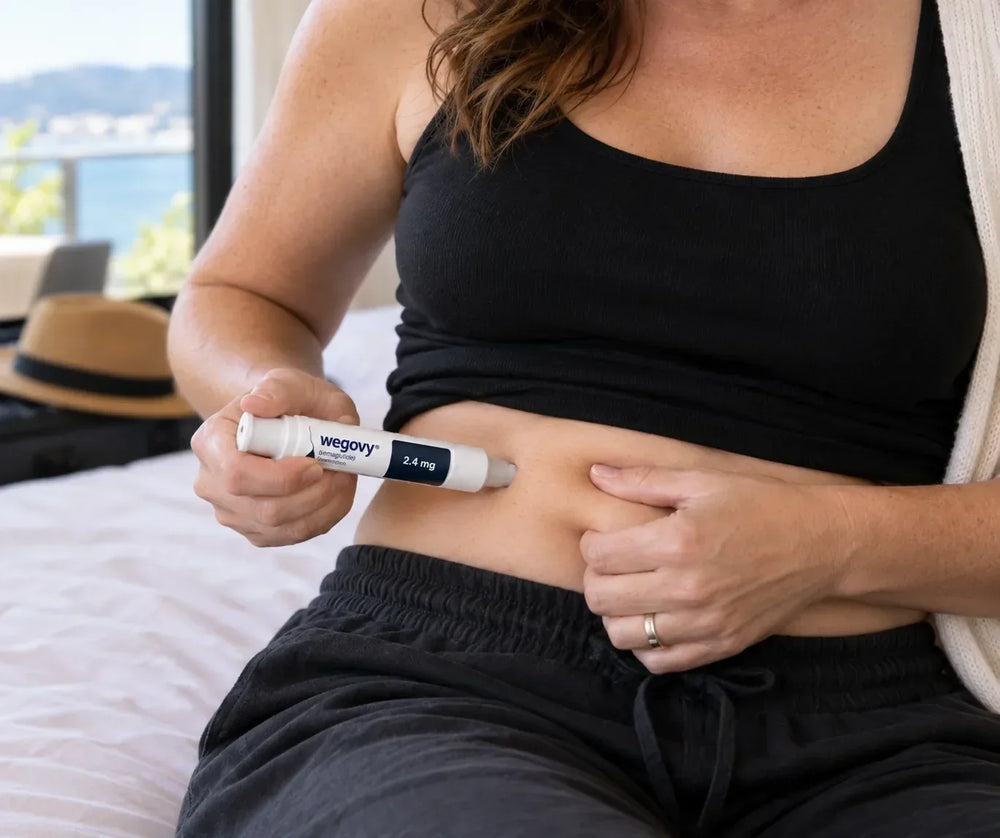
Switching from Ozempic (semaglutide) to Mounjaro (tirzepatide) can change more than your medication. It can also change how you travel with it.
The two medicines have different drug mechanisms, dosing pathways, storage instructions, and device formats. If you travel frequently, that means your cooler case needs to work with the medication you use now—and ideally the one you may use later.
Why people switch from Ozempic to Mounjaro
The decision to switch is clinical and should be made with a healthcare professional.
Current American Diabetes Association guidance recognizes both semaglutide and tirzepatide as highly effective options for people with type 2 diabetes and overweight or obesity. The 2026 Standards of Care emphasize individualizing treatment based on efficacy, tolerability, co-morbidities, cost, and patient preference.
The Obesity Medicine Association also notes that people may switch because of factors such as side effects, insurance coverage, access, or treatment response. It advises that switching and titration should be individualized rather than treated as a simple dose-for-dose exchange.
The dose does not simply transfer across
Ozempic and Mounjaro are not equivalent milligram-for-milligram.
Mounjaro prescribing information currently starts treatment at 2.5 mg once weekly, followed by stepwise dose increases when appropriate.
The Obesity Medicine Association notes that patients switching between semaglutide and tirzepatide generally need a new titration plan rather than converting the old dose directly.
That matters for travel because a medication change close to a trip may mean:
- a new injection schedule
- a different strength
- different side-effect considerations
- different injection pens to pack
If a switch is planned near a trip, confirm the timing with your prescriber rather than making the change independently.
Your travel-storage rules also change
Do not assume that the storage instructions for Ozempic carry over to Mounjaro.
For example, Novo Nordisk says an unused Ozempic pen should be refrigerated at 36°F–46°F (2°C–8°C). After first use, it may be stored for 56 days either refrigerated or at 59°F–86°F (15°C–30°C).
Mounjaro has its own manufacturer storage instructions, which should be checked for the exact presentation you are prescribed.
The practical lesson is simple:
When the medication changes, recheck the travel-storage plan.
Pen size can change too
This is where switching becomes surprisingly practical.
Ozempic uses a multi-dose pen format, while Mounjaro is available in different presentations, including single-dose pens and newer KwikPen formats in the U.S.
That means the shape and amount of space required inside your travel case may change even though both medicines are weekly injectables.
A cooler that works perfectly for a narrow pen may be much less practical when you switch to a wider auto-injector or need to carry several doses.
Before traveling after a medication switch, check:
- the exact device you were dispensed
- how many doses you need
- whether all pens fit comfortably
- whether the pens are separated from frozen cooling components
- whether the case still closes without pressure on the injectors
Do you need to buy a different travel cooler?
Ideally, no.
A medication travel cooler should be chosen around all device compatibility, not one specific drug name.
For someone whose treatment may change from Ozempic to Mounjaro—or later to Wegovy, Zepbound, insulin, or another injectable—a travel cooler case that can fit all different types of pens is more practical than buying a drug-specific cooler every time the prescription changes.
For Eurolabx, this is an important design consideration: the cases are intended to accommodate multiple common injection-pen formats, including narrower pens and wider auto-injectors, so a medication change does not necessarily require replacing the travel case.
The key is to verify the capacity of the specific Eurolabx model against the exact number of pens you are carrying.
What to recheck before your next trip
After switching GLP-1 medications, revisit four things:
Medication: What are the new storage instructions?
Dose: Has your injection schedule or titration changed?
Injection pen: Is the new injector physically larger or shaped differently?
Travel case: Does it hold the required number of doses without direct contact with frozen cooling material?
That 60-second check can prevent assuming that your old packing routine still applies.
Bottom line
Switching from Ozempic to Mounjaro is primarily a medical decision, but it can have practical consequences for travel.
The dose changes, storage guidance needs to be rechecked, and the injection device may take up different space.
If you travel regularly, choosing a cooler that accommodates different common injectable formats can make future medication changes much easier.
Always follow your prescriber’s instructions and the current manufacturer guidance for the exact medication and device you have been dispensed.
_____________________________________________________________________
References:
Obesity Medicine Association — Tirzepatide vs Semaglutide